Steeleye Span Please to See the King Album Review


| Main Index Folio | General Ratings Page | Rock Chronology Page | Song Search Page | New Additions | Bulletin Lath |
STEELEYE SPAN
[Piece of work on the folio in progress]
Class ?
Introduction
Anthology REVIEWS:
- 1971: Please To See The Rex
- 1972: Beneath The Salt
Disclaimer: this page is not written by from the point of view of a Steeleye Span fanatic and is not generally intended for narrow-perspective Steeleye Span fanatics. If you are deeply offended past criticism, non-worshipping arroyo to your favourite artist, or opinions that do non lucifer your own, do not read any farther. If you are non, please consult the guidelines for sending your comments before doing so. For information on reviewing principles, delight see the introduction. For specific non-annotate-related questions, consult the message board.
For reading convenience, please open the reader comments section in a parallel browser window.
Introduction
Coming presently.
READER COMMENTS Department
ALBUM REVIEWS
Delight TO SEE THE KING

Year Of Release: 1971
Overall rating = 11
Electric Celtic/Anglo-Saxon folk, by guys (and gals) who truly understand what they're doing. The only problem is, information technology kinda grates after a while...
Best song: False KNIGHT ON THE RoadRails listing: 1) The Blacksmith; two) Cold, Haily, Windy Night; iii) Jigs: Bryan O'Lynn - The Hag With The Money; iv) Prince Charlie Stuart; five) Boys Of Bedlam; vi) Fake Knight On The Road; 7) The Lark In The Morning; viii) Female Drummer; nine) The King; x) Lovely On The Water.
Yeah, just don't confuse them with Steely Dan - I know the ring names are, as bad-mannered equally it is, structured quite akin, just the two hardly have anything in common. Anyway, the Steeleyes were quite huge in the Seventies, having scored several massive hits in Britain and ever ranking as the equals, or, at least, second best to Fairport Convention as the nation'south greatest folk-rock and Celtic-stone band, and Fairport Convention were no slouches themselves. The big difference was that Steeleye Span went for a much more 'accurate' program - for a large function of their career, none of the band's members actually wrote any songs. Instead, they preferred to scoop up genuine folk songs and medieval-tinged ballads and make their ain arrangements. On the other hand, they relied far more on electric instruments than Fairport Convention ever did; that's not to say that Span's folk stone is really any more 'rocking' than Convention's, but at least that's a unique mode of playing, and this, in plow, makes Steeleye Span a adequately impressive band well worth a page of its own. And I'll probably get around to building that folio as shortly as I go more than albums. I promise. Now, on to the review.
1971 caught the ring in a land of turbulence - really, that's a bit of an excessive expression, since Steeleye's lineup was fifty-fifty less stable than that of Jethro Tull, and that's truly maxim something. All the same, it was that year that also brought them their style: traditional ballads based on ringing, slightly distorted electric guitars, screeching violins and a consummate lack of drums (yeah... well, they do take some kinky percussion, anyhow). This time around, the lineup for their second album stabilized around Ashley Hutchings on the Boom Boom Bass, Maddy Prior on Awesome Astonishing Vocals, Tim Hart on Sweet Sweetness Dulcimer, and two new members to replace the departing Terry and Gay Woods: Peter Knight on Screechy Screechy Violin and Martin Carthy on Slap Slap That Guitar (well, he also sings quite a lot). Before I go any further, though, I must warn y'all: even if virtually of these songs are rather simple in structure and quite accessible, a whole album like that is not so piece of cake to take. After all, traditional Anglo-Saxon ballads, good or bad, are generally based on a limited number of chord progressions, rhythms and moods; and if you don't take an inborn passion for that mode, Steeleye's 'classic menstruum' albums will be fifty-fifty harder to chew than Fairport Convention. I say this because fifty-fifty me, who always goes crazy about medieval European stylizations, well, even me begins to feel somewhat antsy near the middle of the tape. Not to mention that, afterwards all, this is Steeleye's start effort in the genre, and they didn't nevertheless know how to make the individual songs stand up out from each other. I hateful, is there whatsoever meaning difference between 'The Blacksmith' and 'The Distraction In The Forenoon', for instance, or 'Prince Charlie Stuart' and 'Female Drummer'? Okay, so at that place is a lot of difference betwixt both pairs, merely non enough to create specific, individualistic images of each song in my head. The showtime pair is just a couple of lovely wearisome ballads, and the 2d pair is just a couple of funny war songs. And that's how it is gonna stay, despite my being quite fond of all four numbers. Of course, I practice omit the factor of length and monotonousness; when you bargain with British folk-rock, you accept to close your eyes on that or you won't really get far with British folk-stone. You accept to take it with teeth and fists clenched and steam coming out of the nosdrils, merely maybe you'll get used in the end. So permit'southward only accept information technology similar that: the overall way of the tape is beautiful, and when taken individually, each song is cute on its own merits, but there's besides the... the Air-conditioning/DC factor, you know what I hateful. And then once more, I tin can't really blame the ring like I could blame the Young brothers, since they weren't really composing, just instead gathering 'pop beauties' from all corners of the state. And let me concentrate on what I consider the best numbers on the record. Particularly beautiful on hither is the closing track, 'Lovely On The H2o', with some really breathtaking chord changes in Maddy Prior'due south song tune and the near distinguished guitar parts on the album. The guys don't really care that much for soloing, just 'Lovely On The Water' comes closer than anything else to a guitar solo, with a wonderful interplay betwixt the ringing rhythm guitar and the 'vibrating' solo guitar, while Ashley keeps pounding away on the ominous bass. It's so drastically depressing you about want to die... until the fascinating vocals come up dorsum again and kinda save y'all. Only my favourite song is even so the hilarious 'Faux Knight On The Road', with Hart and Carthy taking turns to sing these enthralling lines representing a dialogue between the devil-temptator (Fake Knight) and the innocent male child: "'Equally I wish you were in younder tree,'' says the false knight on the road 'A ladder nether me,' says the wee boy and still he stood 'The ladder it'll break,' says the false knight on the road 'And you will surely fall,' says the wee boy and still he stood". "Withal he stood", past the way, means that the male child gives all the correct answers to the False Knight'southward questions and is thus able to save his soul. Beautiful - lightweight, for certain, only that but makes the vocal stand up out more in the general context of the anthology. All the other songs have their moments, too: 'Common cold, Haily, Windy Night' has more of that amazing guitar coaction, the 'Jigs' part is captivating with its authentic free energy, 'Boys Of Bedlam' is just as creepy as its title would suggest (oh yeah, information technology'south the real Clamor that we deal with), and 'Female Drummer', well, forget what I said about that ane not being distinctive. It almost rocks - the rhythm guitar bashes out a real power-chord rhythm, at least, earlier the vocals come in and things become a bit more than generic. Never listen, though. The vocal's yet good. And did I mention that Maddy Prior has one of rock's all-time female person vocals yet? Probably yes, but I'll just say it once more. Not quite up in that location with Annie Haslam, since she doesn't accept such a mighty range; only certain up at that place with Sandy Denny and maybe fifty-fifty better. Perhaps the main problem on this record is that they don't let her have lead vocals as oft as I'd wish to, only on about half of the album. She is certainly able to make even the most dull song come alive.READER COMMENTS SECTION
Below THE Table salt
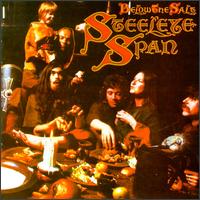
Year Of Release: 1972
Overall rating = 12
A Celtic masterpiece, displaying all the subtleties of the genre without overreaching.
Best song: ROYAL FORESTERTrack listing: 1) Spotted Moo-cow; 2) Rosebud In June; 3) Jigs: The Helpmate'due south Favorite - Tansey's Fancy; 4) Sheep-Crook And Black Dog; 5) Imperial Forester; 6) King Henry; 7) Gaudete; 8) John Barleycorn; 9) Saucy Sailor.
Steeleye Span Mark Three falls in place on hither - both Ashley Hutchings and Martin Carthy are gone, replaced past Rick Kemp on bass and Bob Johnson on guitar. Now this certainly affects the band's sound in many ways, but the most important upshot is that much of the music now sounds less deep and does not pound on your brains so relentlessly. After all, remember that the earlier music was very much based on Ashley's grim, pounding basslines, and McCarthy's thick electrical jangle; this provided a lush 'wall-of-sound' event that was quite unique and unprecedented, just it was also a fleck hard to take when applied to a whole row of songs, one later on some other. Took a lot of time to go used to - imagine that, when you could take spent all that time reading some Hustler!
Hey, I'm non lamenting; I'thousand merely finding an excuse for getting away with two of the ring'due south well-nigh vital members. Anyhow, their replacements are quite solid every bit well, if non as remarkable on their instruments. As a effect, Below The Salt relies far more heavily on audio-visual than its predecessors, but information technology's notwithstanding a 'folk-rock', not pure 'folk' album: the electric lines in 'Spotted Cow', 'Regal Forester' and 'Male monarch Henry' are unforgettable no matter what. Maddy Prior and Tim Hart now mostly have the reins in their easily; Maddy is featured ever more prominently on the record, and that's a good matter; fifty-fifty more interesting, the album spawned their first small striking in 'Gaudete', and oh what a hit it was. Probably the only song by a 'rock' band on Earth that'due south sung completely and entirely in Latin; a hymn taken from the Piae Cantiones, it's not exactly beautiful - well, at least, information technology's not any more beautiful than only about any solid religious hymn ever written. But you lot gotta recall that these dudes aren't really church singers, and the manner they pull off that accapella singing is stunning. And they managed to put this in the charts? A Latin carol? Not even nether the 'gospel' section? This is at to the lowest degree agreeable, even if you hate that kind of music. Only it'southward non 'Gaudete' that makes me rate the album and so high. And it's not 'Sheepcrook And Blackdog', and not the traditional pair of jigs, and not fifty-fifty the pretty, merely inessential version of 'John Barleycorn'. These are all proficient songs, simply they don't really qualify. There are four absolute Celtic stone masterpieces on the album, and each of them adds at least one bespeak to the rating. So 'scuse me, I'll just rant a lil' scrap. In gild of personal preference. 'Spotted Cow' is not particularly amazing in any, well, in any detail sense, only I adore how all the little bits come in so flawlessly. The song tune - and so tricky, so fluent, so pretty and with that eye-wrecking chord modify on the fourth line of each verse. The duet between Maddy and Tim. The prissy acoustic. The ominous distorted electrical notes heralding the first of each verse. And the naive romantic lyrics nigh... well, essentially it's about screwing, but you know they used to sing about it nicely those days. And no, don't worry, it'due south not nearly screwing cows. 'Saucy Sailor', as far as I know, is one of Maddy's favourites - I would take probably missed the song'south charm if I hadn't read about it and hadn't returned back to the song in lodge to capeesh it some more. It'south the anthology closing number, and, simply similar 'Lovely On The H2o' off Please To See The King, it'south dedicated to the subject field of sea, sailors and the eternal 'love vs. coin' subject. A perfect choice to lead us out of the enchanted Steeleye earth, it's not even the main tune of the song itself that's so beautiful, but the extended coda featuring Peter Knight on some funny keyboard device (hey, it'due south not a vibrophone, isn't information technology?) and some obscure chanting done by Tim. 'King Henry', so, is Steeleye Bridge's magnum opus. At seven minutes, information technology'south one of their longest tracks, and while I exercise feel that extending the tune reeks a picayune of artificialness, they do it masterfully. The song itself is marvelous, virtually King Henry'south relations with a 'grisly ghost' that I all the same can't quite understand: he feeds information technology with his horses and hawks, he lays it in his bed, yet he refuses to sleep with information technology, and in the morn he finds out that the ghost has transformed into a beautiful lady. Reward? Whatever. The vocal shuffles on thoughtfully, alternating song sections with an electric guitar solo, a violin solo and yet i more electric guitar solo towards the stop. Information technology's all energetic and powerful, and keeps the listener intrigued - if you ain't read the lyrics canvass beforehand, you'll be fascinated. And now for the grand prize... my favourite number. 'Royal Forester'. Screwing again, damn those obscene Scots. But what about that melody? They play fast and tight, with screeching fiddles and violins in the background while Rick Kemp pumps out a steady bassline. In fact, information technology'south gripping me right now and right away as I put information technology on... hell, essentially it's just a jig, just with vocals overdubbed this fourth dimension. But it'due south not a friendly lightweight jig, it's a disturbing jig with nasty-sounding violins and stuff, and a song melody that'due south supposed to eulogize the royal forester, but instead puts an aura of fear and suspicion effectually him. Well, serve him well; he should take known better than to rape a mysterious lady (the rail is subtitled "the aboriculturist meets superwoman". Makes you wanna grin, doesn't information technology?) Equally all Steeleye Bridge albums are supposed to, chances are that Below The Salt will grow on you and non vice versa. Diehard folk lovers will scream about the immense profundity and deep hidden sense of these songs; screw 'em, there's none (recollect the liner notes to Bob Dylan'south World Gone Wrong where he tried to unsuccessfully market himself as a philologist working on indigenous cloth? A big put-on, that's what information technology was). But in the end, that's what makes them all the more fascinating: these are living songs about living people (and just a few undead ones), and Steeleye Span do a terrific job in making them work in a semi-rocking arrangement. I hateful, folk music volition hardly ever move me to tears - that's what experienced vocalizer-songwriters are for; but the 'authentic feel' on hither is then omnipresent that I accept no pick but to take off my chapeau. Except that I don't take a hat, but I don't think that'll really involvement anyone. What the hell, get buy Beneath The Table salt instead of listening to me and my insane rants. This is, without a doubt, the fashion our friends the Scots and our friends the Centre Englishmen would accept performed these songs had they access to the electric guitar somewhere around the 16th century. Unfortunately, stocks were kinda low in those times...READER COMMENTS Section
Return to the main index page
Source: https://starlingdb.org/music/stspan.htm
0 Response to "Steeleye Span Please to See the King Album Review"
Post a Comment