What does Bromothymol Blue have to do with carbon dioxide?
 | |
 | |
| Names | |
|---|---|
| Preferred IUPAC proper name 3,three-Bis[3-bromo-four-hydroxy-2-methyl-5-(propan-2-yl)phenyl]-2,1λ6-benzoxathiole-ane,1(3H)-dione | |
| Identifiers | |
| CAS Number |
|
| 3D model (JSmol) |
|
| ChEBI |
|
| ChEMBL |
|
| ChemSpider |
|
| ECHA InfoCard | 100.000.884 |
| EC Number |
|
| PubChem CID |
|
| UNII |
|
| CompTox Dashboard (EPA) |
|
| InChI
| |
| SMILES
| |
| Properties | |
| Chemic formula | C 27 H 28 Br ii O 5 S |
| Molar mass | 624.38 m·mol−i |
| Density | ane.25 yard/cm3 |
| Melting indicate | 202 °C (396 °F; 475 K) |
| Solubility in h2o | Sparingly soluble in water[i] |
| Acidity (pK a) | vii.0 |
| Hazards | |
| GHS labelling: | |
| Pictograms |  |
| Signal word | Warning |
| Hazard statements | H302, H315, H319 |
| Precautionary statements | P264, P270, P280, P301+P312, P302+P352, P305+P351+P338, P321, P330, P332+P313, P337+P313, P362, P501 |
| NFPA 704 (fire diamond) | two i 0 |
| Safety information sheet (SDS) | http://www.sciencelab.com/msds.php?msdsId=9927468 |
| Except where otherwise noted, data are given for materials in their standard state (at 25 °C [77 °F], 100 kPa). | |
 Nverify (what is Nverify (what is  Y Y  N ?) N ?) | |
| Infobox references | |


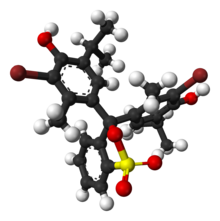
Bromothymol blue (as well known as bromothymol sulfone phthalein and BTB) is a pH indicator. Information technology is generally used in applications that require measuring substances that would take a relatively neutral pH (nigh 7). A common utilise is for measuring the presence of carbonic acrid in a liquid. It is typically sold in solid form as the sodium salt of the acrid indicator.
Construction and properties [edit]
| Bromothymol blue (pH indicator) | ||
| below pH 6.0 | above pH 7.half-dozen | |
| 6.0 | ⇌ | vii.half-dozen |
Bromothymol bluish acts as a weak acrid in a solution. Information technology tin thus be in protonated or deprotonated form, appearing yellowish or blueish, respectively. Information technology is brilliant aquamarine past itself, and greenish-blue in a neutral solution. The deprotonation of the neutral form results in a highly conjugated structure, bookkeeping for the difference in color. An intermediate of the deprotonation mechanism is responsible for the greenish color in neutral solution.[2]
The protonated class of bromothymol bluish has its peak absorption at 427 nm thus transmitting xanthous light in acidic solutions, and the deprotonated form has its peak absorption at 602 nm thus transmitting blue lite in more than basic solutions.[3] Highly acidic Bromothymol blue is magenta in color.
The general carbon skeleton of bromothymol blue is common to many indicators including chlorophenol red, thymol bluish, and bromocresol green.[two]
The presence of one moderate electron-withdrawing group (bromine atom) and two moderate altruistic groups (alkyl substituents) are responsible for bromothymol blue's agile indication range from a pH of 6.0 to 7.6. While the conjugation is responsible for the length and nature of the colour change range, these substituent groups are ultimately responsible for the indicator'due south agile range.[two]

Construction at different pH ranges
Bromothymol blue is sparingly soluble in oil, but soluble in water, ether, and aqueous solutions of alkalis. It is less soluble in nonpolar solvents such as benzene, toluene, and xylene, and practically insoluble in petroleum ether.[four]
Synthesis and preparation [edit]
Bromothymol blueish is synthesized by add-on of elemental bromine to thymol blue in a solution in glacial acetic acid.[5]
To prepare a solution for apply every bit pH indicator, dissolve 0.10 g in 8.0 cmiii N/l NaOH and dilute with h2o to 250 cm3. To prepare a solution for apply as indicator in volumetric work, deliquesce 0.i g in 100 cmiii of 50% (v/v) ethanol.[4]
Uses [edit]

Different colors of bromothymol bluish at marked pH conditions.
Bromothymol blue may exist used for observing photosynthetic activities, or as a respiratory indicator (turns yellowish as COii is added).[six] [vii] A mutual sit-in of BTB's pH indicator backdrop involves exhaling through a tube into a neutral solution of BTB. As carbon dioxide is absorbed from the breath into the solution, forming carbonic acid, the solution changes color from greenish to yellowish. Thus, BTB is commonly used in science classes to demonstrate that the more that muscles are used, the greater the COii output.
Bromothymol blue has been used in conjunction with phenol scarlet to monitor the fungal asparaginase enzyme action with phenol red turning pinkish and bromothymol blue turning blue indicating an increase in pH and therefore enzyme activity.[ citation needed ] However, a contempo written report suggests that methyl red is more than useful in determining activity due to the vivid yellowish ring form in the zone of enzyme activity.[8]
It may also be used in the laboratory every bit a biological slide stain. At this point, information technology is already blueish, and a few drops are used on a water slide. The cover slip is placed on top of the water droplet and the specimen in it, with the blue coloring mixed in.[ clarification needed ] It is sometimes used to define cell walls or nuclei nether the microscope.
Bromothymol is used in obstetrics for detecting premature rupture of membranes. Amniotic fluid typically has a pH > 7.2, bromothymol volition therefore plow bluish when brought in contact with fluid leaking from the amnion. Equally vaginal pH normally is acidic, the blue colour indicates the presence of amniotic fluid. The test may be imitation-positive in the presence of other alkaline substances such as claret or semen, or in the presence of bacterial vaginosis.
See as well [edit]
- pH indicator
- Litmus
- Phenolphthalein
- Methyl orange
- Universal indicator
References [edit]
- ^ "Archived re-create". Archived from the original on 2015-eleven-26. Retrieved 2015-12-eleven .
{{cite web}}: CS1 maint: archived copy as championship (link) - ^ a b c De Meyer, Thierry (March 2014). "Substituent effects on absorption spectra of pH indicators: An experimental and computational study of sulfonphthaleine dyes". Dyes and Pigments. 102: 241–250. doi:10.1016/j.dyepig.2013.10.048. hdl:1854/LU-4353650. Archived from the original on 2020-07-29. Retrieved 2020-03-16 .
- ^ Nahhal; et al. (18 July 2012). "Thin film optical BTB pH sensors using sol–gel method in presence of surfactants" (PDF). International Nano Letters. two (16): 3. Bibcode:2012INL.....2...16E. doi:10.1186/2228-5326-two-xvi. Archived (PDF) from the original on 2014-11-29. Retrieved 18 November 2014.
- ^ a b O'Neil, Maryadele J (2006). The Merck Index. Merck Research Laboratory. p. 1445. ISBN978-0-911910-00-1.
- ^ "Bromothymol blue" (PDF). Archived (PDF) from the original on 27 November 2020. Retrieved 4 April 2020.
- ^ Sabnis R. W. (2007). Handbook of Acid-Base of operations Indicators. CRC Printing. ISBN978-0-8493-8218-5.
- ^ Sabnis R. Westward. (2010). Handbook of Biological Dyes and Stains: Synthesis and Industrial Applications (1st ed.). Wiley. ISBN978-0-470-40753-0.
- ^ Dhale, Mohan (July 2014). "A comparative rapid and sensitive method to screen l-asparaginase producing fungi". Journal of Microbiological Methods. 102: 66–68. doi:10.1016/j.mimet.2014.04.010. PMID 24794733.
External links [edit]
- J.T.Baker MSDS
- Bromothymol Bluish (Sodium Common salt) -Sigma Aldrich
Source: https://en.wikipedia.org/wiki/Bromothymol_blue
0 Response to "What does Bromothymol Blue have to do with carbon dioxide?"
Post a Comment